Queen Clothed in the Livery

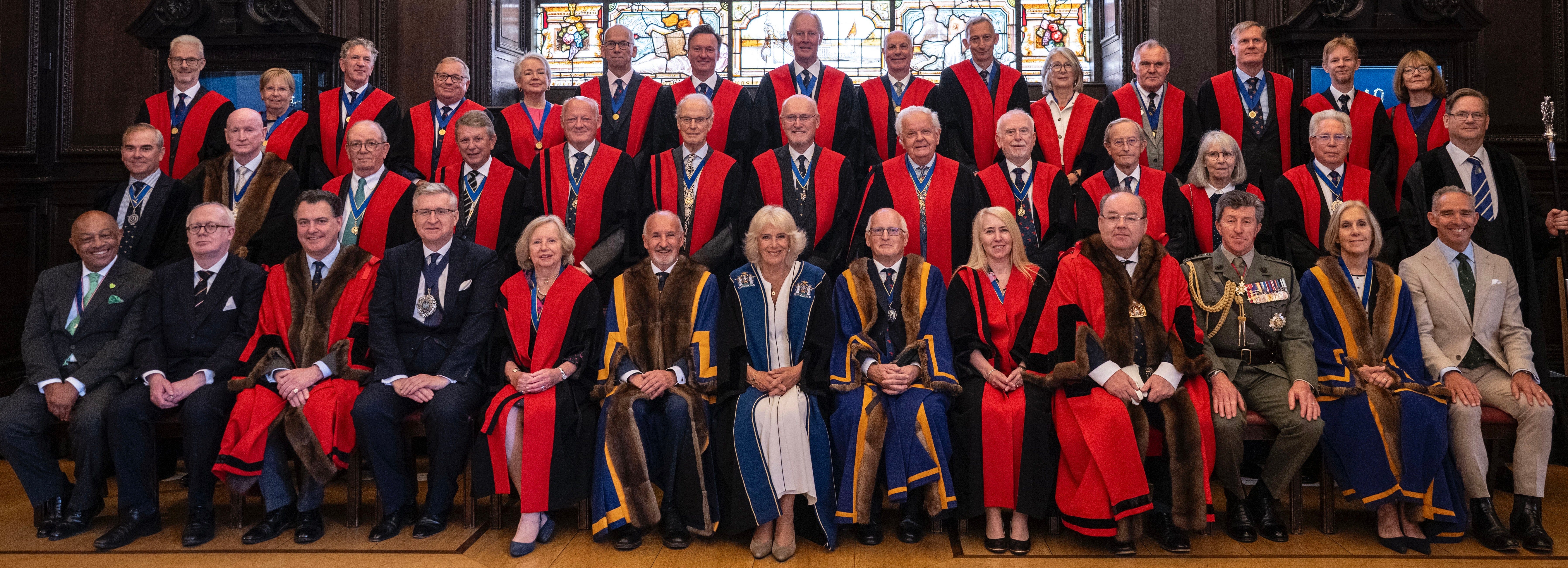
On Tuesday, 15 July 2025, I stood in Stationers’ Hall and watched the Queen of England receive her livery.
I was there by special dispensation. At the time I held the rank of Freeman of the Company — not yet a Liveryman. The Master, Doug Wills, editor emeritus of the London Standard, gave me permission to be present as a witness. He did not have to do that. I am glad he did. I stood alongside Geordie Greig, editor-in-chief of The Independent. Two journalists in a room full of history.
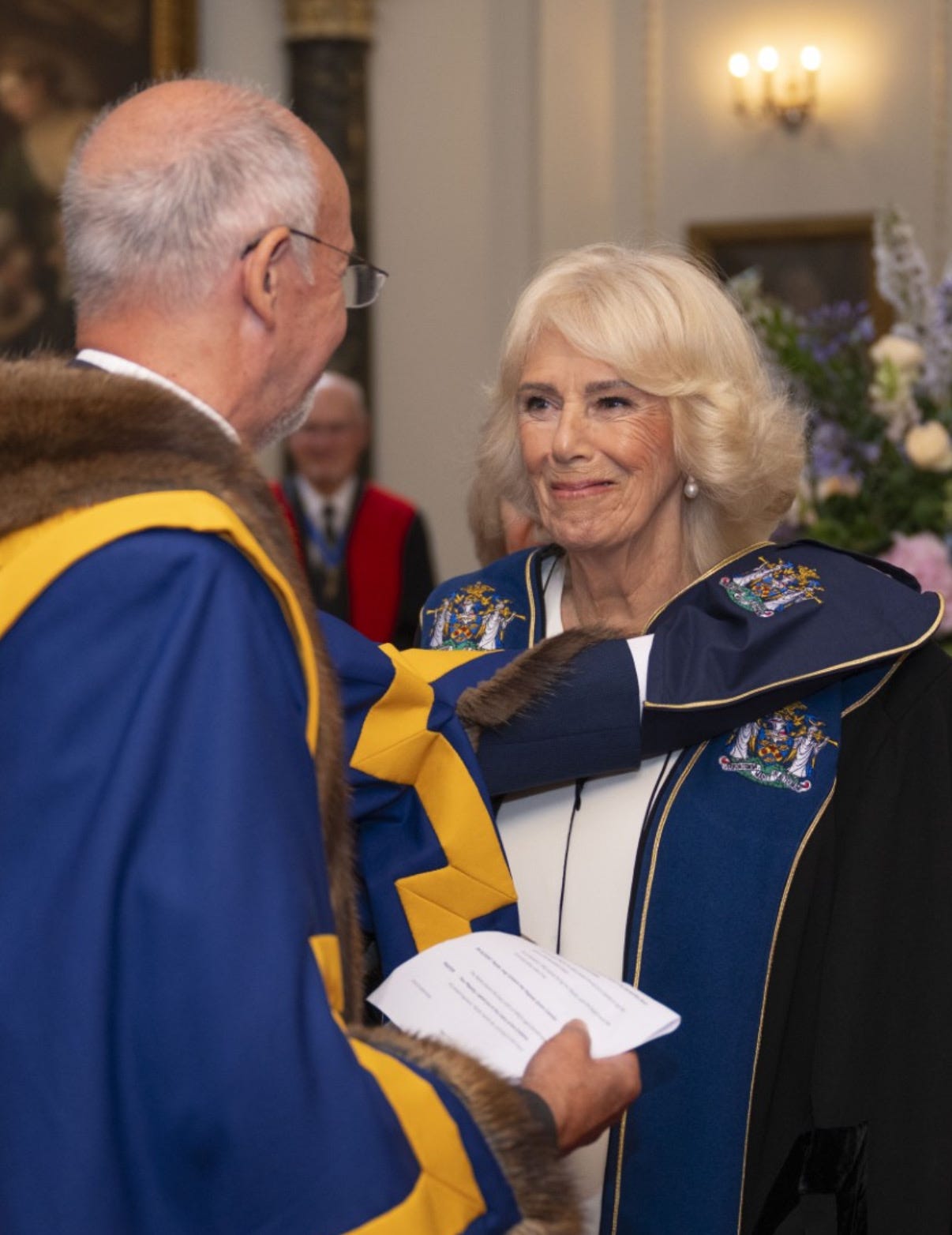
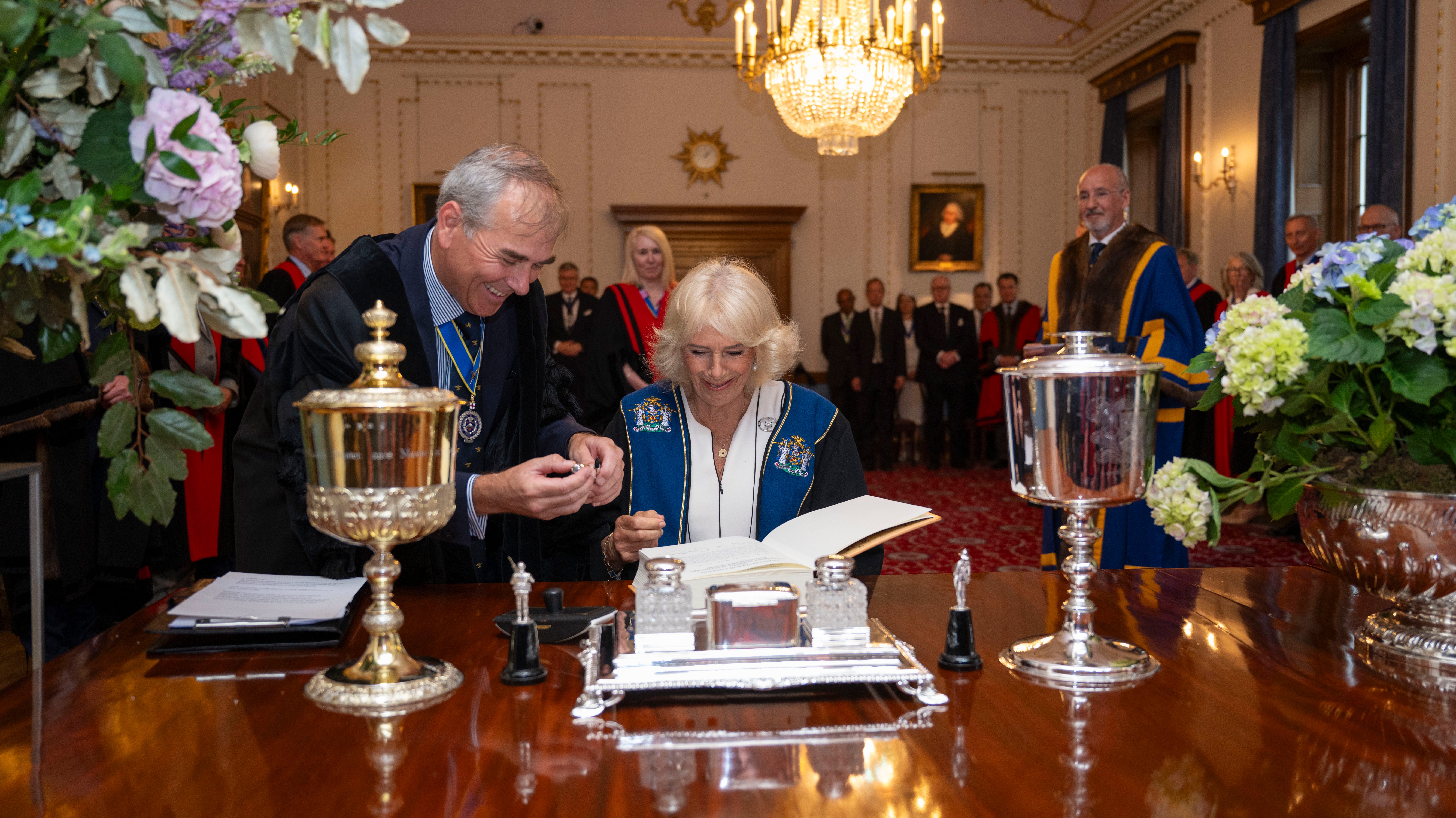
Doug Wills placed the glove of the livery on Her Majesty Queen Camilla’s shoulders. She swore the oath. She signed the documents. She did it without ceremony beyond the ceremony itself. A woman who has spent her public life in the service of books and reading, joining a company that has spent six centuries in the same cause.
The Worshipful Company of Stationers began in 1403. Booksellers and scribes, working the streets around St Paul’s, copying manuscripts by hand and selling writing materials. By the early sixteenth century the printers had joined them. In 1557 the Crown granted a royal charter. The guild became a livery company. It was given powers over the entire printing trade in England — every book, pamphlet and broadsheet had to be registered with the Stationers before it could legally be sold. The copyright registers they kept from that year still exist. The Queen was shown them. She stood and read the 1623 entry recording the right to print the complete works of William Shakespeare. The First Folio. The same ledger. The same ink.
In 1931 the Company of Newspaper Makers was founded, its membership drawn almost entirely from Fleet Street. Six years later, in 1937, a royal charter brought the two companies together into the organisation that exists today. The men of the press and the men of the book, under one roof.
The roll of those who have been honoured before her is worth reading slowly. Rudyard Kipling. James Barrie. W.H. Smith. Sir Basil Blackwell. King Charles joined in 1983, when he was still Prince of Wales. Husband and wife are now Stationers together.
Her Majesty has earned the honour in her own right. For years she has championed reading with a consistency that has nothing performative about it. The National Literacy Trust. BookTrust. Beanstalk. First Story. The Booker Prize. Her Reading Room, which began as the Duchess of Cornwall’s Reading Room and has grown into something genuinely significant. These are not patronages collected for the sake of a list. They reflect a life organised, in part, around the written word.
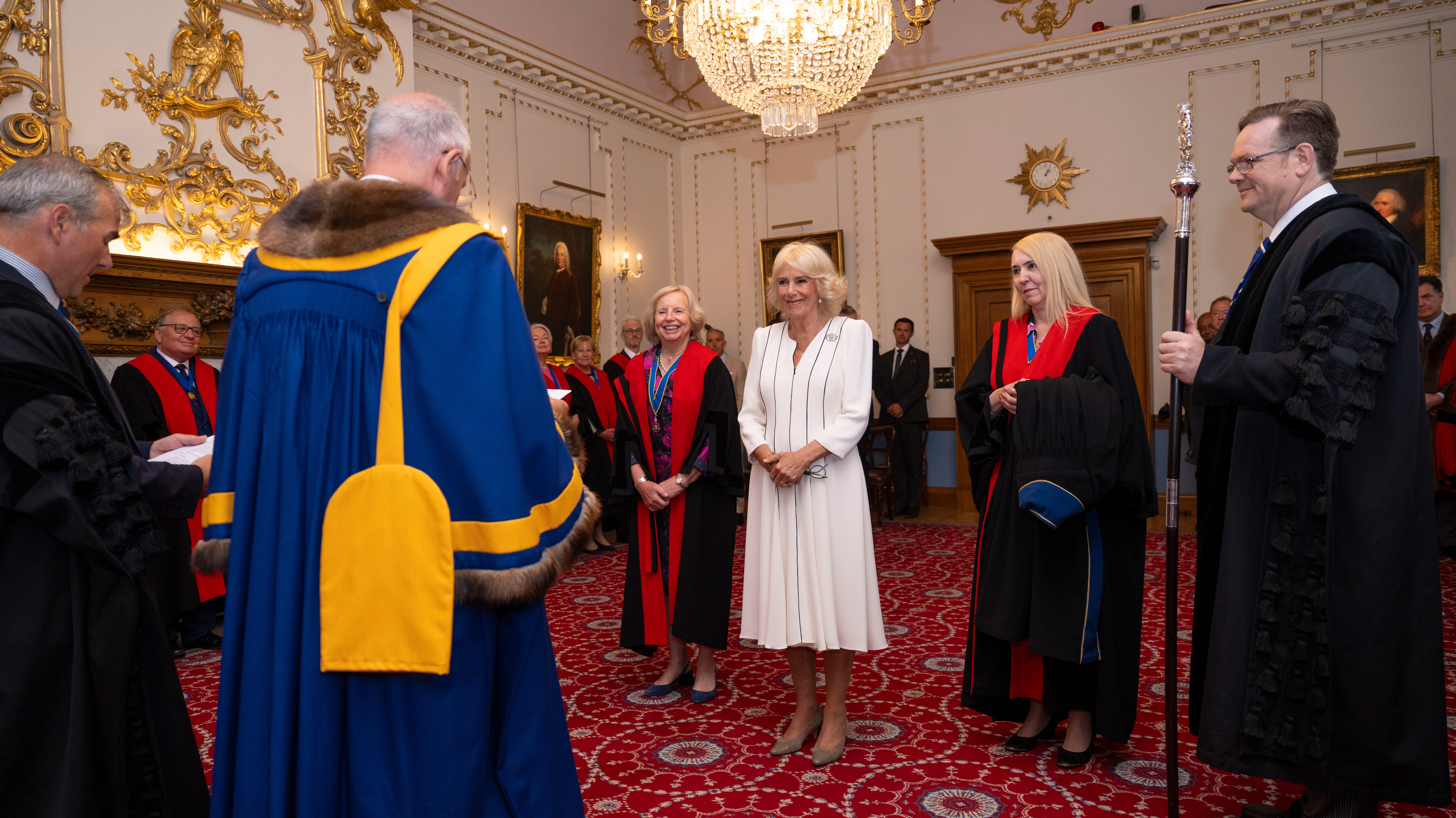
The official witnesses that afternoon included the Lord Mayor of London, Alderman Alastair King, the First Sea Lord General Sir Gwyn Jenkins, Lord Sedwill, Lord Boateng, the City Remembrancer Paul Wright and Geordie Greig. Her sponsors were Helen Esmonde and Moira Sleight — the first two women ever to serve as Master of the Company. The Master presented Lord Boateng, Vice Patron of Book Aid International, with a donation to the charity in the Queen’s honour. She is its patron. Afterwards she toured the Hall, met a young bookbinder trained through her own Royal Bindery Apprenticeship Scheme at Windsor Castle, a programme run in partnership with the Stationers to keep the old craft alive. Then she left. The guests waved white handkerchiefs. It was a lovely moment. I was told later she was touched by the gestures. Three cheers rang out across the courtyard. It is the same farewell that was given to Queen Elizabeth II leaving Balmoral for the last time.
Before I tell you what happened next, walk with me to the foot of Fleet Street.
At Ludgate Circus there is a plaque fixed to the wall. Read it and you understand what the Stationers are, and what Fleet Street was, better than any history book will tell you.
Edgar Wallace, reporter. Born London 1875. Died Hollywood 1932. Founder member of the Company of Newspaper Makers. “He knew wealth & poverty, yet had walked with Kings & kept his bearing. Of his talents he gave lavishly to authorship — but to Fleet Street he gave his heart.” Well that’s what his plaque says. And having lived and loved the life of a Fleet Street hack, I believe I now k now what he means.
He was selling papers on that corner at eleven years old. That was his introduction to the trade. He left school at twelve. Tried a dozen jobs. Joined the army at eighteen and went to South Africa. When the Boer War broke out he got himself taken on by Reuters. The posher correspondents looked down their noses. Churchill, covering the same war for the Morning Post, did not. Wallace worked, filed, and built a name. He came back to London and never stopped writing. Novels, short stories, plays, screenplays, journalism. One publisher calculated that in the 1920s a quarter of all books sold in Britain carried his name on the cover. He wrote twelve novels in 1929 alone. People spoke of getting their weekly Wallace the way they spoke of getting the newspaper.
In late 1931, burdened by gambling debts and facing ruin, he went to Hollywood. RKO gave him a commission. Producer Merian C. Cooper had an idea for a picture about a giant gorilla. Wallace took the bones of it and started writing. He called the first draft The Beast. He worked through December and into January 1932. Then the headaches started. Diabetes, undiagnosed and untreated in a man who drove himself too hard and rested too little. He slipped into a coma in his rented house in Beverly Hills. He died on 10 February 1932. He was fifty-six. King Kong was released the following year. He never saw it.
Back in London, the flags above the Fleet Street offices flew at half-mast. The bell of St. Bride’s, the journalists’ church, tolled for him. The company he had helped to found — the Company of Newspaper Makers — would merge with the Stationers five years later to create the organisation both myself and the King and Queen now belong to.
Nine lines on a plaque. The whole of Fleet Street in nine lines.
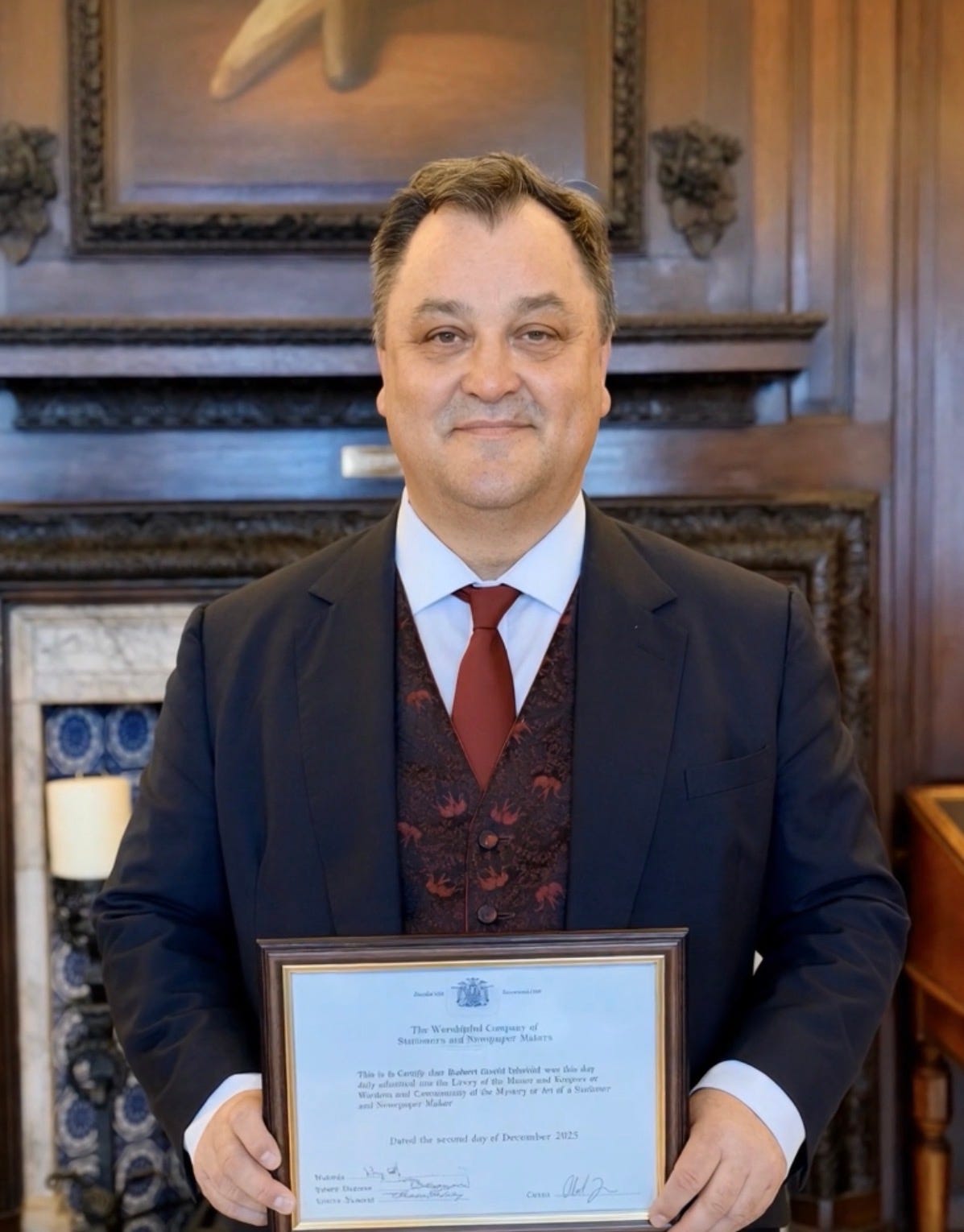
A few weeks after watching the HM The Queen receive her livery, I returned to Stationers’ Hall to be cloathed as a Liveryman of the Worshipful Company of Stationers and Newspaper Makers in the same Master. The same ancient words.
I hold the certificate in the photograph above. It confirms what was done. What it cannot convey is the weight of it. A real sense of history, of Fleet Street and what came before.
As a Liveryman of a City livery company I am also a Freeman of the City of London. The Freedom traces back to 1237. In the medieval city it meant something precise and practical — you were not the property of a feudal lord, you could trade freely, you were protected by the charter of the City. The Clerk at Guildhall extends his hand at the end of the ceremony and greets you as a Citizen of London. He has been saying those words for eight centuries. Among the privileges that come with it is the right to vote in the election of the Lord Mayor and the Sheriffs of the City. Ancient offices. Ancient rights. And yes, the right to drive sheep across London Bridge. I have no immediate plans.
Thirty-five years covering the Royal Family. The Evening Standard. The Daily Express. Conflict zones from Sierra Leone to Kosovo to Iraq. Books. Always books. The word, in all its forms, all its weight.
I remember at the start of my career in national newspapers going to Fleet Street to the old Press Association to collect the first editions and read over the big stories to the Night News Editor of the Sun, Alan Watkins or Barry Mattei. I spent my early career at The Sun as Wapping, HQ to News International them having left their Fleet Street home.
If was the late 1980s when i arrived in “Fleet Street” as papers were moving away from the so called “Street of Shame”.
Stationers Hall, in the Shadow of St Paul’s is a stones throw away from St Brides, the journalists church, and pubs like the “Ye Old Cheshire Cheese” or the “The Punch” or “The Old Bell Tavern.”
Edgar Wallace, Kipling, the Queen .. and me. There are worse companies to keep.
Robert Jobson, this is fascinating history & i learned something new. I very much appreciate your balanced, fair & extremely knowledgeable reporting on the Royal Family & Monarchy. Loving your SS. Thanks.
What a great story! Congratulations on your honor. If you ever decide to drive sheep across London Bridge, we want pictures. 😉